On February 28, 2026, the United States and Israel launched Operation Epic Fury against Iran. No congressional authorization. No UN Security Council approval. Active peace negotiations were underway. A deal was described as “within reach” by Oman’s foreign minister — the day before the bombs fell.
This is not spin. This is the record.
The Supreme International Crime
The Nuremberg Tribunal, established by the United States itself, ruled that the crime of aggression is “the supreme international crime” — because every war crime, every atrocity, every civilian death flows from it.
The UN Charter is unambiguous. Force is legal in only two cases: UN Security Council authorization, or genuine self-defence against an actual or imminent attack. Neither applied here.
Iran had not attacked the United States. Pentagon briefers told congressional staff privately that there was no intelligence indicating Iran was preparing a first strike. The administration invoked “imminence” — then cited incidents from 1979, 1983, and 2000 as its evidence.
That is not imminence. That is pretext.
International law professor Yusra Suedi at the University of Manchester: “There really was no evidence of an imminent threat. If it’s pre-emptive, it means you are acting to counter something that is hypothetical, speculative — and that is exactly what happened here.”
Over 100 international law experts signed an open letter calling the strikes a clear violation of the UN Charter.
Pete Hegseth Told You Exactly What He Was Doing
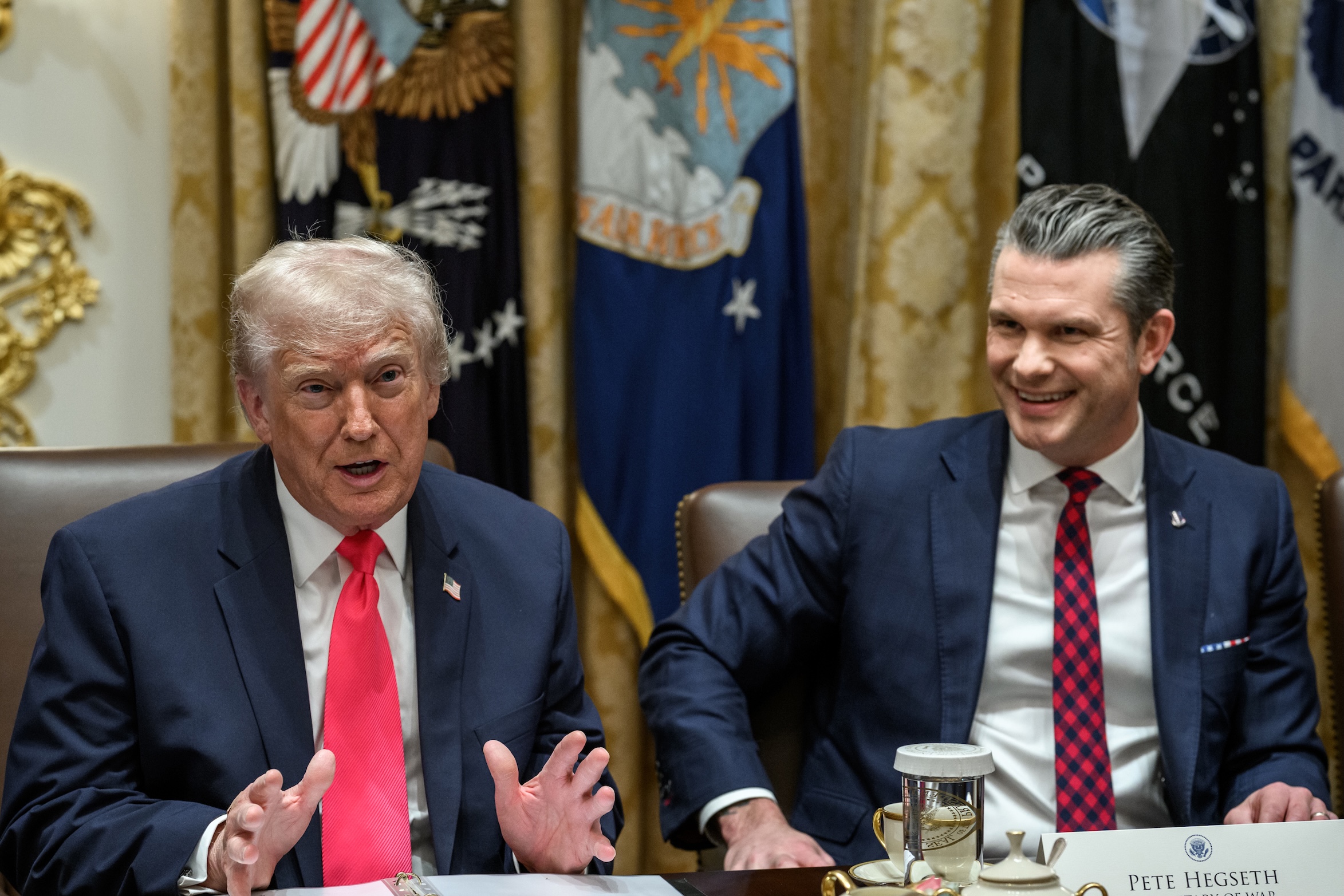
Pete Hegseth — Secretary of Defense, renamed by himself “Secretary of War” — did not hide his intentions. He announced them.
Before the war began, he fired the judge advocates general of multiple military branches — the top lawyers whose job is to keep the military inside the law. He called rules of engagement “stupid.” In his 2024 book he wrote that American soldiers “should not fight by rules written by dignified men in mahogany rooms 80 years ago.”
Day one of Operation Epic Fury, March 2, 2026, Pentagon briefing:
“No stupid rules of engagement, no nation-building quagmire, no politically correct wars.”
March 4: “Death and destruction from the sky all day long.”
March 13: “No quarter, no mercy for our enemies.”
“No quarter” is not rhetoric. It is a war crime. The prohibition dates to the Hague Convention of 1899. It was prosecuted at Nuremberg. It violates the Geneva Conventions, the US War Crimes Act, and the Marine Corps’ own rules of engagement. It means: kill the enemy even when they surrender.
He also dismantled the Pentagon’s “civilian environment teams” — the units whose explicit job was minimizing civilian deaths. The 2026 National Defense Strategy omits the words “civilian protection” and “international law” entirely.
This is not negligence. This is policy.
Minab. 168 Dead. Mostly Girls Aged 7 to 12.
On the morning of February 28, 2026 — the first hour of the war — a Tomahawk cruise missile struck the Shajareh Tayyebeh girls’ elementary school in Minab, Hormozgan Province. Three missiles hit in rapid succession. School was in session. At least 168 people died, the majority children between 7 and 12 years old.
The US initially blamed Iran. Iran does not possess Tomahawk missiles. The US Pentagon has since preliminarily confirmed American responsibility. A targeting error — based on stale intelligence data that classified the school as an IRGC facility, based on the site’s use years prior.
The school had stopped being a military facility. No one checked. The civilians died.
Amnesty International confirmed US Tomahawk missile remnants at the scene. Human Rights Watch called it an unlawful attack and demanded prosecutions. UN experts called it “a grave assault on children.” UNICEF reported more than 1,100 children killed or injured across the conflict in its first two weeks.
The administration initially denied. Then investigated quietly. No accountability. No retraction.
Who Is Accountable — and How
Command responsibility is a cornerstone of international law since Nuremberg: commanders are criminally liable for war crimes committed by subordinates if they knew, or should have known, and failed to prevent them.
Hegseth publicly dismantled the legal safeguards before and during the war. He fired the lawyers. He abolished the civilian protection teams. He announced “no rules of engagement” from a Pentagon podium. The chain of command responsibility leads directly upward.
Accountability pathways that exist now:
- ICC via Article 12(3): Iran can grant the International Criminal Court jurisdiction over crimes on its territory since February 28, 2026 — without being an ICC member. Palestine and Ukraine both used this mechanism. DAWN has formally urged Iran to file.
- US War Crimes Act: No statute of limitations where death results. The death penalty is applicable. Any future administration can prosecute.
- Universal jurisdiction: Multiple EU states and Canada can prosecute war crimes regardless of the nationality of the accused.
- UN General Assembly: Any member state can introduce a resolution declaring the strikes a war of aggression under the UN Charter.
Why This Matters Beyond Iran
The US and Israel went to war without authorization, during active negotiations, and announced in advance they would not follow the laws of war. They struck a school full of children on day one and denied it. They declared “no quarter” — a Nuremberg-era war crime — from a Pentagon press briefing.
If this passes without accountability, the rules-based international order does not merely weaken. It ends.
The Nuremberg precedent was established partly because the United States insisted on it. The argument then: no leader, no nation, is above the law. That argument was correct in 1946. It remains correct in 2026.
The evidence is documented. The statements are on the record. The names are known.
The question now is whether the legal mechanisms built after World War II will be used — or whether they exist only to judge the defeated.
Sources: Just Security, Al Jazeera, Amnesty International, Human Rights Watch, DAWN, Foreign Policy, WBUR/On Point, Wikipedia (2026 Iran war), US Senate letters to Hegseth (Warren, Reed et al.), opiniojuris.org, The Conversation, In These Times, JURIST, FactCheck.org.
Let me hear what you have to say