Kenneth Cohen youtube.com
http://www.qigonghealing.com/
Blog
-
Supreme Court Rules Death Penalty
Supreme Court Rules Death Penalty Is ‘Totally Badass’Background:
Texas executes Mexican murderer BBC 6. August 2008
Court seeks to stay US executions BBC 16. July 2008Perspective:
UN votes for death penalty freeze BBC 18. December 2007
Who stands where on the death penalty BBC 30. December 2006
Death Penalty Information Center deathpenaltyinfo.org -
Postures of the Cheng Man-Ching Tai Chi 37 Form
Zheng Manqing
Traditional Chinese 鄭曼青 Simplified Chinese 郑曼青 Pinyin Romanisation (Mandarin) Zhèng Mànq?ng Wade-Giles Romanisation (Mandarin) Cheng4 Man4-ch’ing1 Other versions Zheng Manqing Cheng Man Ching, CMC Section One
1 預備式 yù bèi shì preparation • 起勢 q? shì commencement 2 攬雀尾 lán què w?i grasp the sparrow’s tail
• ward-off (left side)
• ward-off (right side)
• roll back
• press
• push3 單鞭 d?n bi?n single whip 4 提手 tí sh?u raise arms • ? kào lean 5 白鶴亮翅 bái hè liàng chì white crane spreads wings 6 摟膝拗步 l?u x? ào bù brush knee twist step 7 手揮琵琶 sh?u hu? pípá hand strums the pipa 8 摟膝拗步 l?u x? ào bù brush knee twist step 9 進步搬攔捶 jìn bù b?n lán chuí advance, deflect, parry and punch 10 如封似閉 rú f?ng sì bì apparently closing 11 十字手 shí zì sh?u cross hands Section Two
12 抱虎歸山 bào h? gu? sh?n embrace tiger, return to mountain • 攬雀尾 lán què w?i grasp the sparrow’s tail
• ward-off
• roll back
• press
• push13 斜單鞭 xié d?n bi?n diagonal single whip 14 肘底捶 zh?u d? chuí fist under elbow 15 倒攆猴(五) dào ni?n hóu step back and repulse monkey (5) 16 斜飛式 xié f?i shì diagonal flying 17 雲手(四) yún sh?u cloud hands (4) 18 單鞭 d?n bi?n single whip Section Three
19 蛇身下勢 shé sh?n xià shì snake creeps down 20 金雞獨立 j?n j? dú lì golden rooster, single stance
• right side
• left side21 分腳 f?n ji?o separate leg
• right side
• left side22 轉身蹬腳 zhu?n sh?n dèng ji?o turn body and heel kick 23 左右摟膝拗步 zu? yòu l?u x? ào bù left and right brush knee and twist step 24 進步栽捶 jìn bù z?i chuí advance and plant punch 25 上步攬雀尾 shàng bù lán què w?i rise up and grasp the sparrow’s tail
• ward-off
• roll back
• press
• push26 單鞭 d?n bi?n single whip Section Four
27 玉女穿梭(四) yù n? chu?n su? fair lady weaving (4) 28 攬雀尾 lán què w?i grasp the sparrow’s tail
• ward-off
• roll back
• press
• push29 單鞭 d?n bi?n single whip 30 蛇身下勢 shé sh?n xià shì snake creeps down 31 上步七星 shàng bù q? x?ng rise up to the Seven Stars 32 退步跨虎 tuì bù kuà h? step back and ride tiger 33 轉身擺蓮 zhu?n sh?n b?i lián turn body and swing over lotus 34 彎弓射虎 w?n g?ng shè h? bend bow shoot tiger 35 進步搬攔捶 jìn bù b?n lán chuí advance, deflect, parry and punch 36 如封似閉 rú f?ng sì bì apparently closing 37 十字手 shí zì sh?u cross hands • 合太極 hé tài jí conclude tai chi Reference: singongtaichi.com New Zealand
The number of postures in different Tai Chi styles varies greatly. The original Tai Chi form consisted of 13 postures, based on the 8 trigrams and 5 elements. One of the most widely practiced styles of Tai Chi, Yang Style Long Form, uses a form with 108 postures and generally takes at least 20 minutes to complete.
Professor Cheng Man-Ching studied the Yang Style Long Form with Yang Cheng-Fu, of the famous Yang Family lineage. Professor Cheng was one of Yang Cheng-Fu’s most accomplished students, and was given special permission to shorten the form so that he could teach it more rapidly to the Chinese military during World War II. This shortened 37-posture form eliminated many of the repititions that existed in the long form, while maintaining its essence. Professor Cheng taught it for the rest of his life, continually modifying it in terms of the general shapes of the postures and ultimately transforming it into a form designed primarily for the cultivation of energy (ch’i) and health, differing from its mother form which was designed primarily for martial purposes. Called the Yang Style Short Form during his lifetime, today the form created by Professor Cheng is called the Cheng Man-Ching form, because although his final version of the form roughly follows the Yang Style Long Form, the essense of it is quite different. In spite of the changes Professor Cheng made, his form does not betray its martial roots. Concealed within the postures are the original martial applications. Combining highly-developed softness, sensitivity, and energy as cultivated by Professor’s form with the hidden martial applications is what makes this form particularly powerful.
Professor Cheng stated that one should take at least 7 minutes to perform his form for health benefits, and 10-12 minutes for “something more”. The 37 postures of Professor Cheng Man-Ching’s form are as follows:
1. Preparation – Also known as wu chi or hun-yuan (Undifferentiated Unity)
2. Beginning – or ch’i shih (where you perform the opening breath). Raise hands back and down, more familiarly known as “the ch’i exercise.”
(3a. Preparation for Ward Off, Left – where you relax your shoulders and gain spatial understandings)
3. Ward Off, Left – Also known as tso peng, the foundation of Yang Tai Chi. This is also a great stance to practice rooting in.
4. Ward Off, Right
5. Roll Back – One of Professor Cheng’s favorite defensive postures: essential for the small to overcome the large
6. Press – an opportunity to transmit power through the wrist of the opposite-side hand
7. Push – a vertical movement, unlike the Yang Style Long Form “Push.” The knee and elbow coordinate in this posture.
Postures 3 through 7 are collectively known as “Grasping the Sparrow’s Tail”, which gives the impression of one playing a tugging game with a bird. Your motions should move forward and backward, like waves lapping at the seashore.
8. Single Whip – An excellent posture for chi circulation
9. Raise Hands
10. Shoulder Stroke – A great inside fighting technique
11. White Crane Cools Wings
12. Brush Knee, Left
13. Play Guitar – Also known as Play “Pipa”
Repeat Brush Knee, Left
14. Step Up and Block
15. Parry and Punch – a neutralization is hidden here
Postures 14 and 15 are collectively called Chin Pu, Pan Nan Ch’ui. Professor Cheng distinctly indicated there are two postures here.
16. Apparent Close-up – Also called “Withdraw and Push”
17. Cross Hands
Posture 17 marks the end of the first section of the kung chia, which we call the “Short Half.” This is because it contains approximately half of the total postures in the form and lacks some of the repetitions we find in the second half (thus requiring less time for its performance).
18. Embrace Tiger, Return to Mountain
This is followed by Roll Back, Press, Push; then Single Whip in the direction of the corner (or diagonal).
19. Fist Under Elbow – A good stance to practice one-legged rooting
20. Step Back and Repulse Monkey, Right – Good for loosening hips and improving digestion (front-back foot placement)
21. Step Back and Repulse Monkey, Left – same as above
Follow these with three more repetitions of Repulse Monkey: Right, Left, and Right.
22. Diagonal Flying
23. Wave Hands Like Clouds, Left – Also good for loosening hips and improving digestion (side-to-side foot placement)
24. Wave Hands Like Clouds, Right
Follow these with three more repetitions of “Cloud Hands”: Left, Right, and Left; then go into Single Whip.
25. Single Whip, Lower Style – Also known as “Snake Creeps Up” (or Down). An excellent posture for increasing flexibility, power and single-weightedness
26. Golden Cock Stands on One Leg, Right – Also known by “Golden Pheasant”, this posture teaches balance
27. Golden Cock Stands on One Leg, Left
28. Separation of the Right Foot – Coordinates the hands with kicking
29. Separation of the Left Foot
30. Turn Body and Kick With Heel – Teaches balance while turning and improves flexibility
This posture is followed by Brush Knee, Left and then Brush Knee, Right.
31. Step Forward and Punch
Next, step up into Ward Off, Right; followed by Roll Back, Press, Push, and Single Whip.
32. Fair Lady Weaves (Works) Shuttle I- A textbook example of how defense proceeds offense in Tai Chi
33. Fair Lady Weaves (Works) Shuttle II – A different hand position (opposing hand position).
These postures are followed by Fair Lady Weaves Shuttle III & IV, which are all done towards different corners. Together they are called the “Four Corners”. The “Four Corners” are followed by “Grasping the Sparrow’s Tail” (Ward Off, Left & Right, Roll Back, Press, and Push), Single Whip, and “Snake Creeps Down” or Single Whip, Lower Style.
34. Step Up to Seven Stars – A devastating solar plexus attack.
35. Retreat to Ride Tiger
36. Turn Body Sweep Lotus Leg – Teaches balance while spinning with a crescent kick.
37. Bend Bow Shoot Tiger
This posture is followed by Step Up, Block, Parry and Punch then Apparent Close-up, and lastly Cross Hands, which leads to the close of the Tai Chi form
Reference: http://74.200.201.165
-
Taoist Technique of the Third Eye
Ancient Remote Viewing.
Dr. Baolin Wu, M.D.(China), Ph.D., L.Ac. is a Chinese medical doctor, Taoist physician, and martial artist with over thirty years of medical experience. A recognized authority on traditional Chinese medicine as well as conventional Western medicine, he combines and redefines the techniques of both systems and is able to apply appropriate treatment to complex medical situations.
While Dr. Wu is a skilled practitioner of acupuncture and Chinese herbal science, what sets him apart is his advanced expertise in medical Qi Kung, which he applies to many difficult and otherwise “untreatable” conditions.
Dr. Wu is a Taoist Master from the White Cloud Monastery in Beijing, which for almost a thousand years has been one of the most respected centers in China for the study and practice of Taoist philosophy and medicine. At age four he was brought to the monastery and cured of leukemia. He spent the next twenty years under the direct tutelage of the abbot of the monastery, learning techniques of which few people today are even aware,
Taoist meditation methods have many points in common with Hindu and Buddhist systems, but the Taoist way is less abstract and far more down-to-earth than the contemplative traditions which evolved in India. The primary hallmark of Taoist meditation is the generation, transformation, and circulation of internal energy. Once the meditator has ‘achieved energy’ (deh-chee), it can be applied to promoting health and longevity, nurturing the ‘spiritual embryo’ of immortality, martial arts, healing, painting and poetry, sensual self-indulgence, or whatever else the adept wishes to do with it.
The two primary guidelines in Taoist meditation are jing (‘quiet, stillness, calm’) and ding (‘concentration, focus’). The purpose of stillness, both mental and physical, is to turn attention inwards and cut off external sensory input, thereby muzzling the “Five Thieves”. Within that silent stillness, one concentrates the mind and focuses attention, usually on the breath, in order to develop what is called ‘one-pointed awareness’, a totally undistracted, undisturbed, undifferentiated state of mind which permits intuitive insights to arise spontaneously.
Reference:
Taoist Technique youtube.com -
When I see a butterfly I smile
When I see a butterfly, I smile.
With my eyes I chase the butterfly, my body following.
The butterfly flutters, aimless here and there.
I think, am I not like the butterfly?
 I smile.
 -
Tsa Pi Shiu Lin Jing – Interpret energy
There are many different forms of jing with shenming or Tsa Pi Shiu Lin Jing as the highest form of jing where you sense the opponents jin and yi (intention) before is visible or manifested and you control and release your opponent with Yi (pure intent) or Shen only. (Thomas compilation from different sources)
At this stage the tingjin (listening) has refined into a kind of intuitive sixth sense, jiejin (recieving energy) has be cultivated, and the fajin (relaxed force) has become almost entirely internal. Like the ultimate in dongjin, when your opponents do not move but intent to, you have already moved ahead.
Finally comes the ability to issue without issuing, which is fajin (releasing the relaxed force) by a subconsious direction of the mind, and with out effort.(Taijiquan Wuwei: A Natural Process (okt 2003) Kee-Jin Wee p. 46)
You are able to sense the opponents chi and are able to pass chi into (fajin) or out of him (drain). Thus shocking his internal organs or disrupting his energy flow in the meridians (Dian Xue – pressure point). Understanding the opponents chi pattern with a light touch or without touching at all.
The passive aspect of this jing is the ability to sense the opponents intention (Yi) and resist his chi attacks. ( Advanced Yang Style Tai Chi Chuan: Tai Chi Theory and Tai Chi Jing: 1 (dec 1986) Jwing-Ming Yang p.104 )
Four Character Secret Transmission
Spread. To spread means that we mobilize our chi spread it over our opponents energy and prevent him from moving.
Cover. To cover means that we use our chi to cover our opponents thrust.
Check. To check means that we use chi to check our opponents thrust, ascertain his aim and evade it.
Swallow. To swallow means that we use chi to swallow everything and neutralize.
These four character transmission represents what has no form and no sound. Without the ability to interpret energy and training to the highest perfection, they cannot be understood. We are speaking here exclusively of chi. Only if one correctly cultivates the chi and does not damage it, can one project it to the limbs. The effect of this on the limbs cannot be described in words.
(attributed to Wu Yü-hsiang)
Master Sam Tam are able to to spread the energy over you and prevent you from moving by “sinking the energy”. (Thomas)
Vlad Gaevskiy
Huang Zhen Huan
Morihei Ueshiba -
Light, agile and connected
Once in motion, the entire body must be light (Qing) and agile (Ling), (it) especially should (be) threaded together.
Taijiquan Treatise by Zhang, San-Feng
Jwing-Ming, Dr. Yang, and Ymaa Publication Center. Tai Chi Secrets of the Ancient Masters. P. 1The body’s movement is soft, relaxed, smooth, natural and comfortable.
Light and agile like movements of playing monkeys.
The body must act like a soft whip. Continuous motion like the stream of river or waves of the ocean. Threaded together like Chinese coins or pearls on a string. Mindfulness pervades the whole body. The strength is concealed within softness. Power is instantly available at the touch of a feather. The bow is drawn and ready. Like shouting a cannonball of fire. Like the tale of dragon.
The lightness is not an emptyness; it contains intrinsic energy. The agility is not superficial; it conseals a watchful awareness.
All the parts of the body must be connected like a string of pearls. This means that the movements must exhibit the incessant and continuos flow of a great river.
Rquirements:
- Concentration of the mind.
- Complete relaxation of the body.
- Sinking of the chi to tan tien and abiding by it so that the breathing may be deep and slow.
(Tai Chi Chuan for Health and Self-Defense: Philosophy and Practice T. T Liang) p. 17-18
-
Mindfulness
Mindfulness is awareness of one’s thoughts, actions or motivations.
mindfulness wikipedia.org
Thich Nhat Hanh, Plum Village plumvillage.orgReference:
The shown clip is from the DVD accompanying the book:
Walking Meditation (sep 2006) Thich Nhat Hanh, Anh-Huong Nguyen
ISBN 1591794730
The Miracle of Mindfulness: A Manual on Meditation (dec 1999) Thich Nhat Hanh
ISBN 9780807012390
The Blooming of a Lotus: Guided Meditation for Achieving the Miracle of Mindfulness (jun 1999) Thich Nhat Hanh
ISBN 0807012378 -
The Chinese mind Shen, Xin, and Yi
Shen – Spirit. The consciousness within which the mind and thought function.
Xin – Heart. In Chinese it often means “mind”. If refers to an intention, idea or thought which has not been expressed. The heart or mind, is the center of human thought and feeling.
Yi – Mind. It is commonly expressed as Xin-Yi. Xin is an idea and Yi is the expression of that idea. Therefore “Yi” by it self can be translated as “Mind.” Yi-zhi is will and intention.
Examples:
- Yi Shou Dan Tien – To keep the wisdom mind at the Dan Tian in order to store the Qi.
- Yi Yi Yin Qi – Use the mind to lead the qi
- Qi should be filled and stimulated (Gu Dang),
Shen spirit should be retained internally.
Retaining the Spirit of Vitality internally means to be calm, patient and restrained in your actions. The mind will be concentrated and controlled. (Jwing-Ming, Dr. Yang, and Ymaa Publication Center. Tai Chi Secrets of the Ancient Masters.)
The Mind in Qigong
Stillness, relaxation, and a sort of naturalness are common points for most types of qigong. Stillness means thinking nothing, except the essentials of practicing qigong. Relaxation means keeping the mind and muscles relaxed. “To be natural” means one should follow the natural law and not be nervous.Higher-level qigong common point: Entering the state of nihility. You feel your body are likely to disappear. Entering the nihility is very helpful for health and longevity. In all the common points mentioned above, mastering the mind is the most important. The regulation of breathing is of secondary importance. Therefore, the key to qigong is not the breathing exercise.
Peisheng, W., and C. Guanhua. Relax and Calming Qigong. p.23 “Qigong: mastering the mind”
Ziran – Naturalness
One of Taoism’s core values, ziran refers to naturalness and spontaneity of action, and a state of mind characterized by a kind of mirror-like clarity, which reflects things as they are, unaffected by moral or philosophical overlays. Compare with wuwei, to which it is strongly related. (Ziran taoism.com)The chi should be stimulated and the spirit of vitality should be retained internally.
The principle: Water into steam. When the spirit of vitality is concentrated and retained internally, the heart (mind) will be tranquil and the entire body relaxed so that one may become alert and sensitive.
Tai Chi Chuan for Health and Self-Defense: Philosophy and Practice (maj 1988) T. T Liang p. 18.
Shen Concentrated
Having the above four [red Five Character Secret], then you can return to concentrated spirit: if the spirit is concentrated, then it is (continuous and) uninterrupted, and the practice of chi (breath) returns to the shen (spirit). The manifestation of chi moves with agility. (When) the spirit is concentrated, opening and closing occur appropriately, and the differentiation of substantial and inubsubstantial is clear. If the left is insubstantial, the right is substantial, and vice-versa. Insubstantial does not mean completely without strength. The manifestation of the chi must be agile. Substantial does not mean completely limited. The spirit must be completely concentrated. It is important to be completely in the mind (heart) and waist, and not outside.Not being outside or separated, force is borrowed from the opponent, and the chi is relased from the spine. How is the chi released from the spine? It sinks downward from the two shoulders, gathers to the spine, and pours to the waist. This is chi’i from the up to down is called “closed”. From the waist the chi mobilizes to the spine, spreads to the two arms and flows to the fingers. This is chi from down to up and is called “opened”. Closed is gathering, and opened is discharging. When you opening and closing, then you know yin and yang. Reaching this level your skill will progress with the days and can do as you wish.
Red.: from Li Yi Yu’s Five Character Secret (Calm, Agility, Breath – to gather the chi, The internal force – the complete chin, Spirit – Shen concentrated).
Reference: T’Ai Chi Ch’Uan Ta Wen, Questions and Answers on T’Ai Chi Boxing Chen Wei-Ming ( Benjamin Pang Jeng Lo & Robert W. Smith ) North Atlantic Books 1985
ISBN: 0938190776Page: 55
-
The Circle
The circle is a round plane figure whose boundary (the circumference) consists of points equidistant from a fixed point (the center). Reference: Oxford dictionary
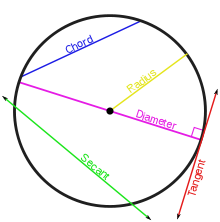
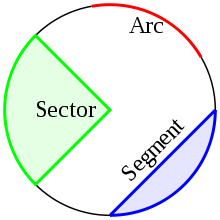
Reference: wikipeda.org
Importance Of Continuity
In the case of the “Outer School” (which emphasizes attack) of boxing, the strength one exerts is still and the movements are not continuous, but are sometimes made off and on, which leaves opening the opponent may take advantage of. In taijiquan, one focuses the attention on the mind instead of force, and the movements from the begenning to the end are continuous and in an endless circle, just “like a river which flows on and on without end” or “like reeling the silk thread off cocoons”.The Ten Essentials of Taijiquan by by Yang Cheng Fu (Recorded by Chen Wei Ming)
The central feature of the postures is the combination of an empty circle which has form and a formless circle which is full. These two circles represent the principle of the “empty” and “substantial.” Within the postures there is an apparent emptiness, but the posture is not really empty; it appears to be substantial, but there is in reality emptiness. This qi flows to all places without obstruction. It is rounded and lively without angles. It is without excesses or deficiencies. When manifest, the Six Harmonies are complete. When returning, it is hidden as a treasure within. Its changes are without limit. Its uses are inexhaustible. Herein lies the real teachings. It is the sum of Tai Ji Quan.
Chen Xin’s Boxing Treatise says it best, “When your practice is most refined, even the smallest place is circular” Every sphere has its center. Within the sphere that issues from this central pivot, there are no breaks, deficiencies, hollows or projections. So where can there be double weighting? There is a saying, “Adhering is moving away. Moving away is adhering.” The term “Taiji” actually means the center of a circle, where the outer portion is called yang and the inner portion yin [that is, outside the circle and inside the circle]. Yang is applied by adhering and attacking. Yin is applied by moving away and defending. Furthermore, adhering is preparation for moving away. and moving away is preparation for adhering. Thus, we can continue, “Yin does not depart from yang; yang does not depart from yin.” It can also be said, “Yin and yang balance each other; this is known as “comprehending energy” (dong jing). What is called “yin and yang, adhering, moving away, hard and soft, following” and so on are all words referring to attacking and defensive movements. Within the attack, there is defense, and within defense, there is an attack. For this reason, we speak of “mutual balance”. Recognizing this principle is equivalent to “comprehending energy”.
A Study of Taiji Push-Hands by Xiang Kairen
He could only give him advice on a few movements, like Single Whip (Dan Bian) and “Luo Lu” or circles made with the hands and waist in three different planes, to train how to change the hand position correctly in order to dissipate incoming force and strike simultaneously, but without using strength.
4 ounces deflects a 1000 pounds by Dong Bin
“Avoid turning circles without any purposes. Make sure that there is “yi” (mind/intent) in every one of your moves. You need to stand up and face your opponents and should not run away from them.”
“Do not treat push-hands lightly, thinking it involves only turning circles, some pushes and power discharge. We should treat it like fighting an enemy who is trying to kill us. Once we get in contact with his arms we should be able to control him, and we should not be controlled by him.”
Finer points of yiquan push-hands by Yao Cheng-rong
Ren Gang says that in push hands or sparring etc, one must first look upon the opponent not as a separate entity that you must defeat – The Enemy – but as a part of you, a part of your energy circle.
How to train your spirit and energy to drive the body by Ren Gang
Retreat in order to advance (Yi Tui Wei Jin).
In pushhands the feature of prime importance is to adapt and move with the changing conditions of your counterpart. The circular movements in Taichi are the image of the symbol of taichi, which is evolving, comprising the changes of moving and adhering within a circle.The circular movements (Dong Zuo Zou Hu Xian).
The patterns of interchange between yin and yang are all based on circular movements and connected by “sticking ” to the partner’s intension. Because there is no interruption in a circular movement, it is easier to reach the partner than in a forward or backward straight line. Another benefit is that it is easier to change your acting force or direction at any point of the circular line.About the principles of wu-style taichichuan by Ma Jiangbao
Yi is responsible for relaxing the external body, the muscle; for storing the Qi one develops in practice, for making smaller circles and spirals, for condensing movement to small frame, and eventually to no visible movement in order to develop Nei Jing.
Therefore you only have to make the Light circulate: that is the deepest and most wonderful secret. The Light is easy to move, but difficult to fix. If it is allowed to go long enough in a circle, then it crystallizes itself: that is the natural spirit -body. This crystallized spirit is formed beyond the nine Heavens. It is the condition of which it is said in the Book of the Seal of the Heart: Silently in the morning thou fliest upward.
The Golden Flower by Master Lu Tzu
Sun Anguang -
Mocabu – Friction or Chicken Steps
Asume the basic standing posture, but with the arms out to the sides at about navel height an sligthly forward crouch a little as if sitting down slightly and keep the back erect. When one is relaxed and the attention collected, shift one’s weight completely onto the right foot and strain on the hip. Move the left foot straight back a half a step then forwards in an inward curve, brushing past the right instep and out forwards to a place in front of its original position, turning the toes out a bit as is lands. Shift the weight forward on to the left leg, turning the torso slightly to the left as one does so, then bring right foot forward in a curve past left instep and out to the front, turning toes out slightly as it lands. Shift weight onto the wright leg again, turning torso slightly to the left as one moves, then take another a step with left foot. Continue forwards and then backwards in this was for as long as comfortable.
When taking a pace, raise the knee slightly, keep toes straight and do not raise foot to far off ground. It should feel as if dragging one’s feet through mud, and as gentle as if one were rolling a ball along with one’s toes. Again the motion must be smooth and unbroken.
(Traditional Chinese Therapeutic Exercises: Standing Pole (dec 1994) J.P.C. Moffett, Wang Xuanjie p. 65-67)There are many kinds of stepwork in Dachengquan, and Mocabu or friction step is the most basic one. The posture is as follows: Stand naturally with two feet in parallel, apart form the legs which bend slightly at the knee, the posture is like standing attention. Keep torso erect, shoulders relaxed, arms stretched sideways, forming an angle of about 60 degrees with the body. With fingers parted naturally and palms facing downward as if you where pressing two big balloons, raise the head upright and drop to half a squat, with chest in and back intense. See that you have abundant energy, a quiet and easy mind and a substatiel abdomen. After standing in this way for some time, with the body weight on the soles of the feet, shift weight onto the left hip and slowly move right foot horizontally in a small arc to the right with the toes forward and land right on outer right side. The shift the weight onto the right hip, and move left foot in the same way as the right one has just done, and lands on the outer left side. The feet are desirably keept one foot length and a half apart all the time. Repeat the above mentioned movements alternatively with one foot and another. In practising this skill, care must be taken that the knee-cap is accompanied be an intention of a slight up-lift, toes are slightly hooked and the sole is not to high above ground. At the same time imagine that two feet are walking in shallow water, overcoming resistance. All the movements should be steady and flexible flowing easy and comfortable. This is the advacing posture. For retreating posture, just reverse the order of movements.
A ballad for Mocabu goes as follows:
With the torso erect and the head upright, He walks like a chicken but with torso a bit inclined.
Advance or retreat at will as the hip and shoulder move, Weaves rise and fall as the knee leaps and the foot circles.
(Dachengquan (jul 1988) Wang Xuanjie p. 48-49)
Kenneth Cohen
Yao Zongxun
Yao Chengrong
Wang Xuanjie -
Structure
 The ‘classics’ state that; the body has to be upright as if the head is suspended from above; the hips have to be relaxed and seated into their sockets; the chest should be hollowed; shoulders relaxed and elbows dropped. These requirements combined create the taiji ‘structure’.
However if all the attention in placed on the structure without having an awareness of the processes and details in the movements, the structure will be empty and without substance.
(from Practicing the Classics by by Wee Kee-Jin) http://www.taijiquan.co.nz/ -
The pivot of Central Equilibrium
Static equilibrium
When a system of forces acting on an object produces no motion, the system is said to be in static equilibrium.Mechanical equilibrium
A rigid body is in mechanical equilibrium when the sum of all forces on all particles of the system is zero, and also the sum of all torques on all particles of the system is zero.A rigid body in mechanical equilibrium is undergoing neither linear nor rotational acceleration; however it could be translating or rotating at a constant velocity.
Alternative definition
A system is in mechanical equilibrium if its position in configuration space is a point at which the gradient of the potential energy is zero.Because of the fundamental relationship between force and energy, this definition is equivalent to the first definition. However, the definition involving energy can be readily extended to yield information about the stability of the equilibrium state.
Reference: Mechanical equilibrium wikipedia.org
What is the rationale for relaxing the abdomen and withdrawing the coccyx (or tailbone)?
Qi is stored in the Dan Tien as a result of using consciousness to sink the Qi to this point. From here Qi should circulate to the whole body. If Qi just remains in the Dan Tien, then the abdomen will have the sensation of being stuffed. Only when Qi circulates throughout the body will the abdomen be relaxed and pliable. After a time, the abdomen will acquire some “bouncy” or “springy” effect and Qi would have been circulating to the whole body. Qi can be occluded or absorbed into the backbone. The Song of the Thirteen Postures says, “If the abdomen is thoroughly relaxed, then the Qi will rise.” So do not just store the Qi in the abdomen otherwise it will simply bloat. Having the coccyx withdrawn means there is no protrusion of the buttocks while making sure at the same time that the hip joints are not “sliding” forward. This must be combined with relaxing the abdomen and both requirements must be met at the same time. Otherwise, there is no rootedness while the waist is stiff, resulting in vertical imbalance or disequilibrium. It is important to maintain the uprightness of the central axis of the body in order to achieve central equilibrium. A test can be made as follows to see whether all this has been done correctly all along: use one thump to press the abdomen and release the thumb suddenly. There should be a bouncing or springy effect of the abdomen. At the same time, the seat of the buttocks behind should be very soft to the touch.
Huang Sheng-Shyan
Find Center!
Relax the chest.
Raise the back.
Enclose the solar plexus.
Protect the cheekbones.
Lift the head.
Suspend solar plexus.
Loosen the shoulders.
Sink the elbows.
Be evasive.
Avoid conflict.
(Wu-Yü-hisiang)Taiji is born of Wu Chi. It is the origin of dynamic and static states and the mother of yin and yang. If they move, they separate. If the remain static, they combine.
(Wangzongyue)We are centered, stable and still
as mountain.
Our Chi sinks to the tan-t’ien and
we are as suspended from above.
Our Spirit is concentrated within and
our outward manner perfectly composed.
Receiving and issuing energy are
both the work of an instant.
(T’an Meng-hsien)Just stay centered in the Now.
(Eckhart Tolle)Taiji quan Kongfu of Master Zhu Datong 2
Zhu DatongTaiji quan Kongfu of Master Zhu Datong 3
Zhu DatongTaiji quan Push-hand of Master Zhu Datong 2
Zhu DatongLinks:
Song of Central Equilibrium dyhr.com


You must be logged in to post a comment.